
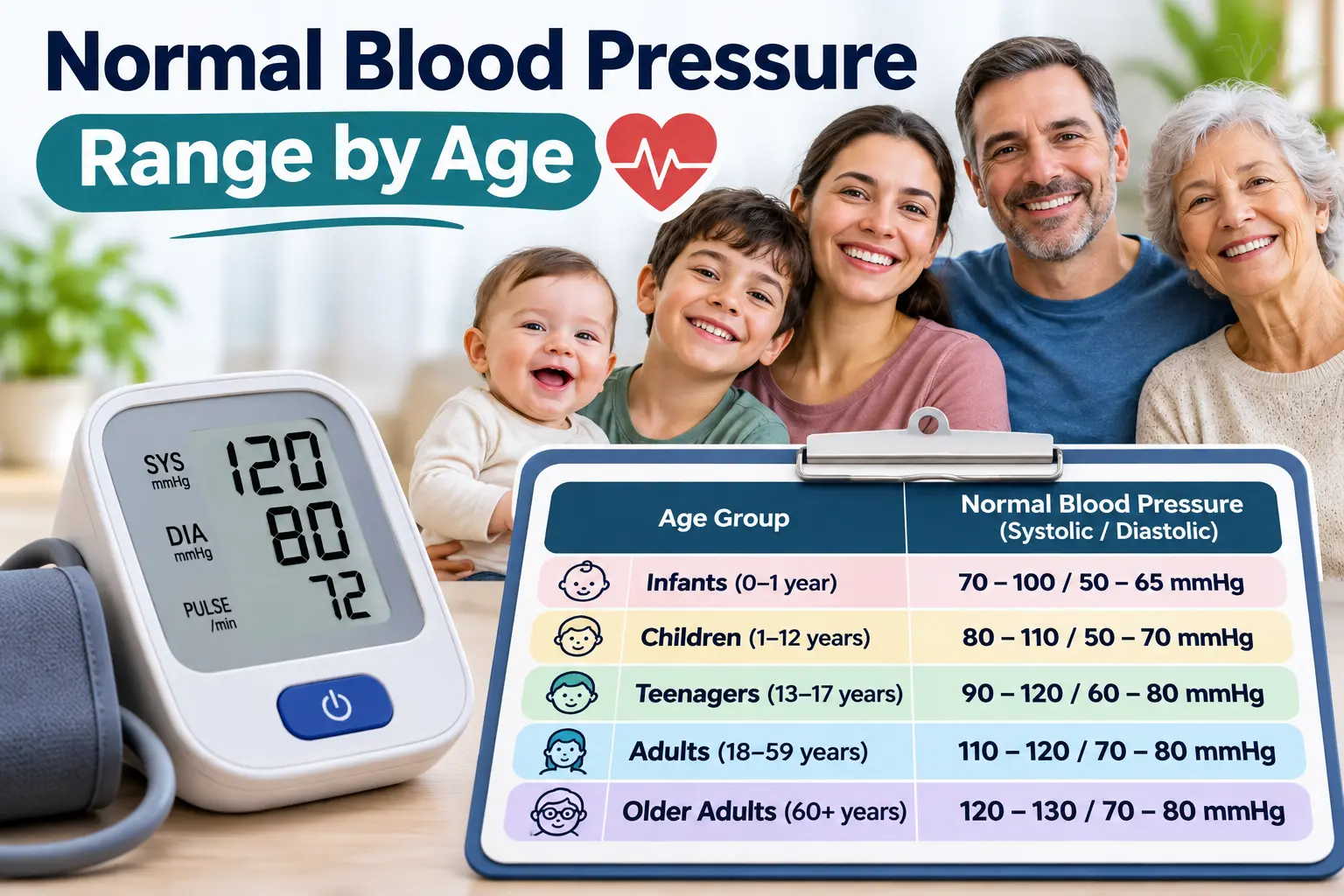
Blood pressure is one of the simplest and most important numbers for your health, yet many people do not know what their reading means. Is 130/85 normal at 40? Is 140/90 acceptable at 70? Do children have the same range as adults?
This guide explains what blood pressure numbers mean, the normal range at different ages, and what to do if your reading is too high or too low.
What Is Blood Pressure?
Blood pressure is the force of blood pushing against the walls of your arteries as the heart pumps. It is written as two numbers, for example 120/80 mmHg:
- Systolic (top number): pressure when your heart beats and pushes blood out
- Diastolic (bottom number): pressure when your heart rests between beats
Both numbers matter. If either one is consistently high, your risk of heart disease, stroke, kidney problems, and other conditions rises.
Normal Blood Pressure Categories for Adults
For adults, the categories are broadly the same at every age. These follow the American Heart Association and American College of Cardiology guidelines.
| Category | Systolic (top) | Diastolic (bottom) | |
|---|---|---|---|
| Normal | Below 120 | and | Below 80 |
| Elevated | 120–129 | and | Below 80 |
| High BP, Stage 1 | 130–139 | or | 80–89 |
| High BP, Stage 2 | 140 or higher | or | 90 or higher |
| Hypertensive crisis | Above 180 | and/or | Above 120 |
Note: Some guidelines, including parts of Europe and India, use slightly different cut-offs, such as treating 140/90 as the threshold for diagnosing hypertension. Your doctor will decide what is right for you.
Normal Blood Pressure Range by Age
Newborns, Infants, and Children
In children, normal blood pressure depends on age, sex, and height, and doctors compare readings against growth-based percentile charts. The ranges below are approximate guides only.
| Age Group | Approximate Normal Range (mmHg) |
|---|---|
| Newborns (0–1 month) | 60–90 / 20–60 |
| Infants (1–12 months) | 75–100 / 50–70 |
| Toddlers (1–3 years) | 80–110 / 50–75 |
| Preschoolers (3–5 years) | 85–115 / 55–75 |
| School-age (6–12 years) | 90–120 / 55–80 |
Teenagers (13–17 years)
From age 13, doctors use thresholds close to adults. A reading below 120/80 is considered normal. Teens who are overweight, have kidney problems, or have a family history of hypertension should be checked regularly.
Young Adults (18–39 years)
The healthy target is below 120/80. Many young adults have no symptoms of high blood pressure, so occasional checks are important, especially with a family history, obesity, stress, or heavy salt intake.
Middle-Aged Adults (40–59 years)
The target is still below 120/80, but this is when blood pressure begins to creep up for many people because of weight gain, stress, inactivity, and arteries becoming less flexible. Yearly checks are a good idea.
Older Adults (60+ years)
Blood pressure tends to rise with age because arteries stiffen. Many guidelines advise a target of below 130/80 for older adults if they can tolerate it, though doctors may aim for a slightly higher target in people who are very frail, are over 80, or have a history of falls or dizziness. Isolated high systolic pressure (high top number, normal bottom number) is especially common after 60.
What Is Low Blood Pressure (Hypotension)?
A reading below 90/60 mmHg is generally considered low. For some healthy people, especially young, fit individuals, this is normal and causes no problems. It matters if you also have:
- Dizziness or lightheadedness, especially on standing
- Fainting
- Blurred vision
- Nausea
- Fatigue or confusion
- Cold, clammy skin
Low blood pressure can be caused by dehydration, blood loss, heart problems, hormone issues, infections, or certain medicines. Seek medical advice if you have symptoms.
Why Blood Pressure Rises With Age
- Arteries become stiffer and less elastic
- Plaque can build up inside blood vessels
- Kidneys become less efficient at regulating salt and fluids
- Weight gain and reduced physical activity
- Hormonal changes, including after menopause
- Long-term conditions such as diabetes and kidney disease
Symptoms of High Blood Pressure
High blood pressure is often called the “silent killer” because most people feel nothing at all. When symptoms do appear, usually at very high levels, they may include severe headache, chest pain, shortness of breath, blurred vision, nosebleeds, or confusion. The only reliable way to know is to measure it.
How to Measure Blood Pressure Correctly
- Sit quietly for 5 minutes before the reading.
- Keep your back supported, feet flat, and legs uncrossed.
- Rest your arm at heart level on a table.
- Use a correctly sized cuff on bare skin, not over clothing.
- Avoid caffeine, smoking, and exercise for 30 minutes beforehand.
- Do not talk during the reading.
- Take two readings one minute apart and note the average.
- Check at the same time each day if monitoring at home.
A single high reading does not mean you have hypertension. Doctors look at the pattern over several measurements.
How to Keep Blood Pressure in a Healthy Range
- Cut down on salt. Aim for less than 5 g of salt (about one teaspoon) a day.
- Eat more fruits, vegetables, and whole grains, and foods rich in potassium such as bananas and leafy greens.
- Stay active. Aim for at least 150 minutes of moderate exercise a week, such as brisk walking.
- Maintain a healthy weight. Even a few kilos lost can lower blood pressure.
- Limit alcohol and avoid smoking.
- Manage stress through sleep, relaxation, and breaks.
- Get enough sleep, since poor sleep is linked to higher blood pressure.
- Take prescribed medicines regularly, and do not stop them without your doctor’s advice.
When to See a Doctor
See a doctor if:
- Your home readings are repeatedly 130/80 or higher
- Your readings are consistently below 90/60 with symptoms
- You have a family history of high blood pressure, diabetes, or heart or kidney disease
- You are pregnant and notice a rise in blood pressure
Seek emergency care immediately if your reading is above 180/120 and you have chest pain, shortness of breath, severe headache, weakness, vision changes, or difficulty speaking.
Final Thoughts
A healthy blood pressure for most adults is below 120/80, though targets may be adjusted with age and health conditions. Because high blood pressure usually has no warning signs, regular checks are the best protection. Know your numbers, build healthy habits early, and talk to your doctor about what is right for you.
Disclaimer: This article is for general information only and is not a substitute for professional medical advice, diagnosis, or treatment. Always consult a qualified healthcare provider about your blood pressure.
Frequently Asked Questions
A normal blood pressure for adults is below 120/80 mmHg. Readings of 120–129 over less than 80 are considered elevated, and 130/80 or higher is classed as high blood pressure by most US guidelines.
Blood pressure tends to rise with age, but the healthy target for adults stays largely the same. For children, normal ranges depend on age, sex, and height. For very elderly or frail people, doctors may set a slightly higher target.
A reading of 140/90 is considered high (Stage 2 by US guidelines) at any adult age. Some guidelines use it as the threshold for starting treatment. A doctor will assess your overall risk before deciding what to do.
Many guidelines suggest aiming for below 130/80 if tolerated, but a doctor may recommend a slightly higher target depending on overall health, medications, and risk of falls.
It varies with age and height. As a rough guide, school-age children are usually around 90–120 over 55–80 mmHg. Doctors use percentile charts to interpret a child's reading.