
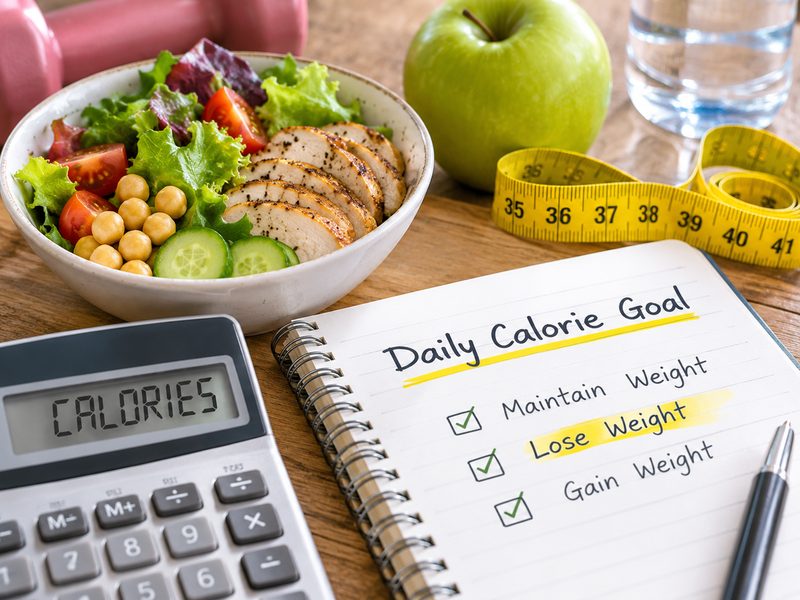
Most adults lose weight steadily by eating about 500 calories a day below what they burn. For many women that works out to roughly 1,400 to 1,600 calories a day, and for many men roughly 1,900 to 2,200, though your own number depends on your size, age and activity. This guide shows you how to find your personal target, how fast to aim to lose, and where the safe lower limits sit, so you can cut calories without crashing your energy or your health.
Key takeaways
- Start by estimating your maintenance calories, the amount that keeps your weight steady, then subtract about 500.
- A deficit of 500 calories a day usually produces about 0.5 kg (1 lb) of loss per week. A safe pace is 0.5 to 1 kg (1 to 2 lb) a week.
- Typical weight-loss targets are about 1,400 calories a day for women and 1,900 for men, but these are averages, not prescriptions.
- Without medical supervision, avoid going below about 1,200 calories a day for women or 1,500 for men.
- The old 3,500-calorie rule is only a rough guide. Weight loss slows as you lose weight, so recheck your target as you go.
- Food quality matters. Protein, fibre and whole foods keep you fuller on fewer calories.
How weight loss works: the calorie deficit
Your body burns calories all day, even at rest. If you eat fewer calories than you burn, it makes up the gap by drawing on stored energy, mostly body fat. That gap is called a calorie deficit. Eat more than you burn and you gain weight. Eat about the same and your weight holds steady.
Your daily energy use, called total daily energy expenditure (TDEE), has four parts:
- Basal metabolic rate (BMR): the energy your body needs just to stay alive, such as breathing, circulation and cell repair. It makes up the largest share, usually 60% to 70% of daily burn.
- Daily movement outside exercise: walking, fidgeting, housework and standing, often called NEAT.
- Exercise: planned workouts and sport.
- Digesting food: a small share, around 10%.
Two people of the same weight can burn quite different amounts. Height, age, sex, muscle mass, hormones and certain medicines all play a part, which is why no single number suits everyone.
Average daily calorie needs
Before working out your own number, it helps to see typical maintenance levels. These are approximate estimates based on US dietary guidelines for adults of average size.
| Group | Sedentary | Moderately active | Active |
|---|---|---|---|
| Women, 19 to 30 | 1,800 to 2,000 kcal | 2,000 to 2,200 kcal | About 2,400 kcal |
| Women, 31 to 50 | About 1,800 kcal | About 2,000 kcal | About 2,200 kcal |
| Women, 51 and over | About 1,600 kcal | About 1,800 kcal | 2,000 to 2,200 kcal |
| Men, 19 to 30 | 2,400 to 2,600 kcal | 2,600 to 2,800 kcal | About 3,000 kcal |
| Men, 31 to 50 | 2,200 to 2,400 kcal | 2,400 to 2,600 kcal | 2,800 to 3,000 kcal |
| Men, 51 and over | 2,000 to 2,200 kcal | 2,200 to 2,400 kcal | 2,400 to 2,800 kcal |
Sedentary means mostly sitting with little exercise. Moderately active means about 3 to 5 days of exercise a week or a fairly active job. Active means daily hard exercise or a physically demanding job.
Needs drift down with age, mainly because muscle mass falls. The UK’s NHS uses about 2,000 calories a day for women and 2,500 for men as general maintenance figures.
How many calories should you eat to lose weight?
The simplest approach is to take your maintenance calories and reduce them. The NHS weight-loss plan suggests a deficit of about 600 calories, which brings its targets to roughly:
| Group | Typical weight-loss target |
|---|---|
| Average woman | About 1,400 kcal a day |
| Average man | About 1,900 kcal a day |
Other guidance recommends a deficit of 300 to 500 calories a day, which is gentler and easier to stick to for people who are smaller, older or less active. Either way, the numbers above are starting points. Use the steps below to find a figure that fits you.
How to calculate your own calorie target in 3 steps
Step 1: Estimate your BMR
The Mifflin-St Jeor equation is widely used and tends to be accurate for most people. Use your weight in kilograms (W), height in centimetres (H) and age in years (A).
BMR_{men} = 10 \times W + 6.25 \times H - 5 \times A + 5BMR_{women} = 10 \times W + 6.25 \times H - 5 \times A - 161Step 2: Multiply by your activity level
Multiply your BMR by the factor that best fits your week to get your maintenance calories.
| Activity level | Multiplier |
|---|---|
| Sedentary (desk job, little exercise) | 1.2 |
| Lightly active (exercise 1 to 3 days a week) | 1.375 |
| Moderately active (exercise 3 to 5 days a week) | 1.55 |
| Very active (hard exercise 6 to 7 days a week) | 1.725 |
| Extremely active (physical job plus training) | 1.9 |
People tend to overestimate activity, so if you are unsure, pick the lower level.
Step 3: Subtract 300 to 500 calories
Take your maintenance figure and subtract 300 to 500 calories. Keep the result above the minimum safe floor described below.
Worked examples
| Woman | Man | |
|---|---|---|
| Age, weight, height | 35 years, 70 kg, 165 cm | 40 years, 90 kg, 178 cm |
| Activity | Lightly active (1.375) | Moderately active (1.55) |
| BMR | About 1,395 kcal | About 1,818 kcal |
| Maintenance (TDEE) | About 1,920 kcal | About 2,820 kcal |
| Weight-loss target (500 kcal deficit) | About 1,420 kcal | About 2,320 kcal |
Notice the man’s target is well above the NHS average of 1,900. That is because he is larger and more active than average. This is why a personal calculation beats a one-size-fits-all number.
Calculators and apps can do the maths for you, but remember they give estimates. Eat at your target for two to four weeks, track your weight, and adjust by 100 to 200 calories if the scale is not moving.
How fast should you lose weight?
A steady rate of 0.5 to 1 kg (1 to 2 lb) per week is widely recommended. It is fast enough to see progress and slow enough to protect muscle, energy and mood.
The maths behind this is often explained with the 3,500-calorie rule: roughly 3,500 calories, or about 7,700 per kilogram, equals one pound of body fat, so a 500-calorie daily deficit adds up to about 1 lb a week. It is a handy rule of thumb, but real life is messier. As you lose weight, your body burns fewer calories, and you may move a little less without noticing. Water, hormones and muscle changes also move the scale. Expect loss to be faster in the first weeks and then slow down.
Losing weight faster than 1 kg a week for a long time can mean losing muscle, feeling worn out, and gaining the weight back. A bigger deficit is not automatically better.
What is the lowest safe calorie intake?
Eating too little backfires. It can cause fatigue, hair loss, headaches, poor concentration, low mood, constipation, gallstones and nutrient deficiencies, and it often leads to rebound overeating.
Without medical supervision, commonly used lower limits are:
| Group | Suggested minimum without medical supervision |
|---|---|
| Women | About 1,200 kcal a day |
| Men | About 1,500 kcal a day |
Very-low-calorie diets of around 800 calories a day or less should only be followed under a doctor’s care, usually for people with significant obesity and a clear medical reason. Your own safe minimum may be higher if you are tall, very active or have lots of muscle.
Calories in kcal and kJ
In most countries, food energy is labelled in kilocalories (kcal), which people simply call calories. Some countries, including Australia and New Zealand, also use kilojoules (kJ), and the EU shows both. One kcal equals about 4.2 kJ. So 1,400 kcal is about 5,900 kJ, and 1,900 kcal is about 7,950 kJ.
How to spread your calories through the day
There is no single best pattern, so pick what you can stick to. A simple split looks like this:
| Meal | Share of daily calories | At 1,400 kcal | At 1,900 kcal |
|---|---|---|---|
| Breakfast | About 25% | About 350 kcal | About 475 kcal |
| Lunch | About 30% | About 420 kcal | About 570 kcal |
| Dinner | About 30% | About 420 kcal | About 570 kcal |
| Snacks and drinks | About 15% | About 210 kcal | About 285 kcal |
Some people prefer three bigger meals, others do better with four or five smaller ones. Total calories and food quality matter more than timing.
Calories are not the whole story
1,400 calories of vegetables, beans, eggs, fish and whole grains feel very different from 1,400 calories of pastries and soft drinks. To feel fuller and protect muscle while you lose weight:
- Eat enough protein. Many adults do well with roughly 1.2 to 1.6 g per kg of body weight a day, spread across meals. Check with your doctor first if you have kidney disease.
- Fill up on fibre. Vegetables, fruit, legumes, oats and whole grains add volume for few calories.
- Choose mostly whole foods. Ultra-processed snacks are easy to overeat and rarely satisfy.
- Drink calories sparingly. Sugary drinks, juice and sweetened coffee can add 200 to 500 calories a day without making you feel full.
- Watch liquid extras and cooking oils. A tablespoon of oil is about 120 calories, and it adds up quickly.
Easy ways to cut 500 calories a day
You do not have to count every bite. Small swaps can make up the deficit:
- Swap two sugary drinks for water or unsweetened tea: about 250 to 300 kcal saved
- Swap a large pastry or biscuit snack for a piece of fruit: about 150 to 250 kcal saved
- Cut a large restaurant portion of rice, pasta or fries by a third: about 150 to 200 kcal saved
- Walk briskly for 45 minutes: about 150 to 250 kcal burned, depending on your size
- Choose grilled or baked over deep-fried: about 100 to 300 kcal saved
Mix food changes with more movement. Exercise alone rarely creates a big deficit, but it protects muscle, improves mood and makes the plan easier to keep.
Should you count calories?
Tracking can be an eye-opener, since people often underestimate what they eat. A food diary or app is useful for a few weeks to learn portion sizes. It does not suit everyone, though. If counting makes you anxious, obsessive or guilty about food, stop and use simpler habits such as portion control, plate balance and regular meals. If you have ever had an eating disorder, talk to a doctor or dietitian before trying to cut calories.
Who should talk to a doctor first?
See a healthcare professional before reducing calories if you:
- Are under 18, pregnant or breastfeeding
- Have diabetes, especially if you use insulin or tablets that can cause low blood sugar
- Have kidney, liver or heart disease, or another long-term condition
- Take regular medicines, since weight loss may change the dose you need
- Have a history of an eating disorder
- Have a lot of weight to lose and are considering a very-low-calorie diet
A doctor or registered dietitian can set a safe target and check for medical causes of weight gain, such as thyroid problems.
Why you might stop losing weight
If your weight stalls for more than three or four weeks, the cause is usually one of these:
- Your maintenance has dropped. You weigh less, so you burn less. Recalculate and adjust.
- Calorie creep. Portions, snacks and drinks slowly grow, and weekends erase the weekday deficit.
- Less everyday movement. You may be sitting more without noticing.
- Poor sleep and high stress. Both affect hunger hormones and appetite.
- Inaccurate tracking. Estimates of portions are often off by 20% or more.
A short, planned break at maintenance calories can also help you keep going.
Final thoughts
The right calorie target is the one that puts you in a modest deficit, keeps you above the safe minimum and fits your real life. Work out your maintenance, cut 300 to 500 calories, build meals around protein and fibre, and recheck every few weeks. Steady and sustainable beats fast and fragile.
Disclaimer: This article is for general information and is not a substitute for professional medical advice, diagnosis or treatment. If you have a health condition, take medicines or are unsure how much to eat, talk to a doctor or registered dietitian.
Frequently Asked Questions
Subtract 300 to 500 from your maintenance calories. For an average woman that is about 1,400 to 1,600 calories a day, and for an average man about 1,900 to 2,200, but your size, age and activity change the figure.
Most people will lose weight on 1,200 calories, but it is the minimum rather than a goal. For many adults, particularly men and active women, it is too low to meet nutrient needs. Start higher and only go lower with a doctor's guidance.
For many women who are moderately active and for smaller or less active men, 1,500 calories creates a reasonable deficit. For larger or more active people it may be too low.
One kilogram of body fat is about 7,700 calories, so losing 1 kg a week needs a deficit of roughly 1,100 calories a day. That is aggressive and not suitable for many people. Aim for 300 to 500 calories a day and be patient.
Maintenance is usually around 1,600 to 1,800 calories, so a weight-loss target is often about 1,300 to 1,500. Protein and strength training matter even more at this age, to protect muscle and bone
Not necessarily. If you set your target using an activity multiplier, your exercise is already counted. If you used the sedentary level and then add workouts, you may need a little more food on very active days.
Most people notice changes in weight, energy and how clothes fit within two to four weeks. A common healthy pace is 2 to 4 kg (4 to 9 lb) a month, with faster loss in the first weeks.